

Developing Marine Patterns
A broad, highly distinct elongated trough of low pressure extending southwestward from offshore Baja California down into the deep tropical Pacific is acting as the primary driver of current offshore marine conditions along the western side of the peninsula. This unique atmospheric setup has successfully broken apart and backed off the typical oceanic high-pressure ridge to the west, maintaining an unusually light to moderate wind gradient across the open offshore Pacific waters.
The extensive interaction between this sprawling marine trough and the super-heated thermal low over the interior deserts is dictating real-time coastal airflow, forcing extensive moisture inland. Concurrently, a weak upper-level low-pressure center spinning just off the central coast is throwing heavy, stratified tropical clouds and active convective radar cores across the peninsular landmass. Offshore water temperatures reflect a highly anomalous pattern, displaying exceptionally hot sea surface baselines down at the cape confluence that transition to an incredibly cool, robust upwelling zone along the central Pacific coastline.
Rather than local wind seas, the open Pacific waters are currently dominated by an aggressive, highly energized southerly to south-westerly swell train. This long-period swell energy is actively propagating northward from the southern hemisphere with wave periods peaking up to an impressive 15 seconds, keeping swell energy alive down the coastline. Further south, the decaying remnants of Cristina have officially degenerated into a weak surface trough near the coast of El Salvador, while localized low-pressure troughing inside the Gulf of California continues to distort typical seasonal wind channels, driving an energetic southwesterly to southeasterly convergence zone right up the basin.

Regional Marine Reports
Northern Baja Pacific
Offshore waters from the international border south to El Rosario are experiencing mostly cloudy skies as a thick marine layer compresses against the coastal valleys. Winds are holding from the west-southwest to west between 6 and 12 mph from Tijuana through Ensenada, while San Quintín sees west-northwesterly winds at 8 to 16 mph during the afternoon window. Coastal sea surface temperatures near Ensenada and San Quintín remain stuck in a very cool range, creating a sharp thermal boundary right at the shoreline. A persistent northwest swell is active across this entire sector, maintaining combined significant wave heights of 6 to 8 feet, which spike up to a much rougher 7 to 9 feet well offshore.
Baja California Sur Pacific
Along the central and southern Pacific coastlines, sky conditions are highly unstable as thick mid-level convective clouds and active thunderstorm cells stream across the region. Marine environments from Guerrero Negro down to San Juanico are witnessing a cloudy profile with active thunderstorms, bringing fresh northwesterly to westerly winds with gusts ranging from 10 to 20 mph. Near San Carlos and Todos Santos, conditions feel partly cloudy and a bit warmer, with northwesterly wind speeds tracking around 10 to 20 mph in San Carlos and 10 to 15 mph in Todos Santos. Combined seas throughout these open waters are holding steady between 6 and 8 feet, driven by the dominant southerly swell train.
Northern Gulf of California
Conditions across the upper basin near San Felipe and Puertecitos are staying in a warm range this morning under mostly cloudy skies, with active rain cells pushing over the shallow water. Winds are blowing fresh out of the east-southeast at 10 to 20 mph in San Felipe and south-southeast at 10 to 20 mph in Puertecitos, while San Luis Gonzaga sees east-southeasterly flow at 12 to 25 mph. This active gradient is bringing warm air across the coastline, creating a light to moderate surface chop with localized seas building to 3 feet or less across the shallow channels.
Southern Gulf of California
The lower basin, including the waters off Loreto, Mulegé, and La Paz, is basking under partly cloudy skies and a much warmer thermal profile, with isolated thunderstorms fracturing the afternoon marine boundary near Mulegé. Winds around Loreto are light to moderate out of the east-southeast at 6 to 14 mph, while Mulegé experiences northeasterly breezes at 10 to 20 mph. Near La Paz, winds originate from the west-southwest at 8 to 15 mph. While the daytime ambient air remains a lot hotter than the Pacific coast, marine breezes inside the southern Gulf of California are stable, keeping local seas running gentle at 3 feet or less.
Los Cabos
At the extreme southern tip of the peninsula, open-water conditions remain highly favorable for daytime operators under partly cloudy skies as the convective remnants of Cristina merge into the monsoon trough. Winds are currently blowing from the west at speeds of 15 to 25 mph near Cabo San Lucas, while Los Barriles sees northeasterly breezes at 6 to 14 mph under sunny skies. Water temperatures at the confluence are holding at very warm levels, and while a moderate northwest swell is mixing with the primary southern swell train offshore, coastal seas remain highly manageable, averaging 4 to 6 feet closer to shore.

Marine Warnings and Hazards
Offshore Wind and Sea Hazards
Real-time offshore maritime data from the National Hurricane Center indicates that fresh to occasionally strong northwest winds will continue to impact the open waters outside the 60-nautical-mile coastal boundary today. Small craft operators should exercise heightened awareness from the United States border region down through Punta Eugenia, as combined seas are peaking up to 9 feet within the northern sectors, creating choppy conditions across the offshore banks where the northerly and southerly swell energies are directly clashing.
Swell and Surf Warnings
Additionally, marine forecast models indicate that the current southerly swell train will remain highly energized over the next 24 hours, carrying long wave periods of 15 seconds deep into the northern sectors. Significant wave heights of 7 to 10 feet are actively tracking through the offshore waters north of 27°N. These heightened, long-period waves will continue to propagate northward and eastward through Friday, generating steep, heavy surf and treacherous rip currents along all exposed outer reefs, rocky points, and south-facing beaches.
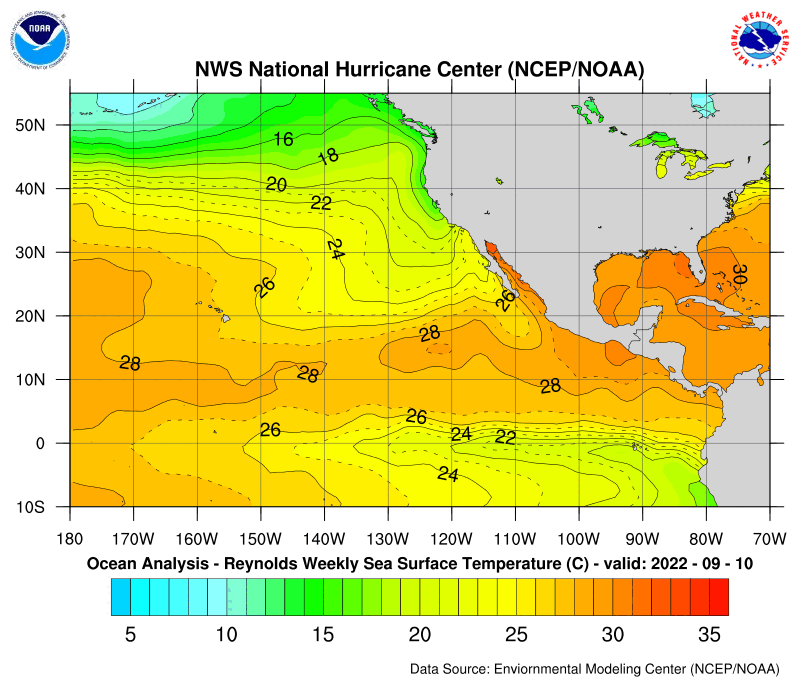
Seawater Surface Temperatures (SSTs)
The Gulf of California Thermal Surge:
Over the last 48 hours, we see a distinct warming trend climbing straight up the upper Gulf. Bahía de Los Ángeles, Bahía San Luis Gonzaga, Puertecitos, and San Felipe have all spiked by 1 to 2 degree, with Santa Rosalía surging a massive 3 degrees to hit 80°F . This sudden shallow-water warming in the upper Gulf acts as a high-octane fuel tank. It dramatically destabilizes the boundary layer, explaining why the radar (Image 3) shows severe, moisture-rich convective cores ripping directly over the San Felipe zone and tracking straight into the northern Gulf.
The Southern Tropical Inflow:
Down at the cape, Cabo San Lucas has leapt 3 degrees in 48 hours to reach a hot 81°F, while Los Barriles has climbed to 84°F. This aggressive warm-water tongue indicates that the decaying tropical energy and moist monsoon boundary from Cristina are successfully pushing a deep marine thermal matrix northward. This highly volatile, high-dew-point maritime air mass is what the mid-level cut-off low is tapping into, throwing a deep column of moisture straight up the spine of the peninsula.
The West Coast Upwelling Boundary:
On the Baja Pacific side, the data proves why the immediate coastline is heavily stratified. Stations like Cabo San Quintín and Erendira (63°F) are completely flatlined and locked into cool baselines, while Bahía Asunción has actually dropped to a chilly 59°F. This indicates robust localized upwelling. However, just north of this upwelling zone, the unseasonable warmth highlighted by the NWS Scripps Pier data (70.3°F) is reflected in Playas de Tijuana holding at an elevated 68°F.
Brutal Thermal Contrast:
A super-heated desert interior and a warming upper Gulf sitting right next to an icy, upwelled Pacific boundary layer. The resulting coastal pressure and temperature differentials are compressed to an extreme degree. This explains the explosive orographic lifting and the immediate, accelerated precipitation cells we are seeing on the radar right over the central and northern coastal valleys.