

Current Weather Conditions
Satellite-Radar Imaging - NE Pacific

National Hurricane Center (NHC) Morning Update

Regional Forecast for Today
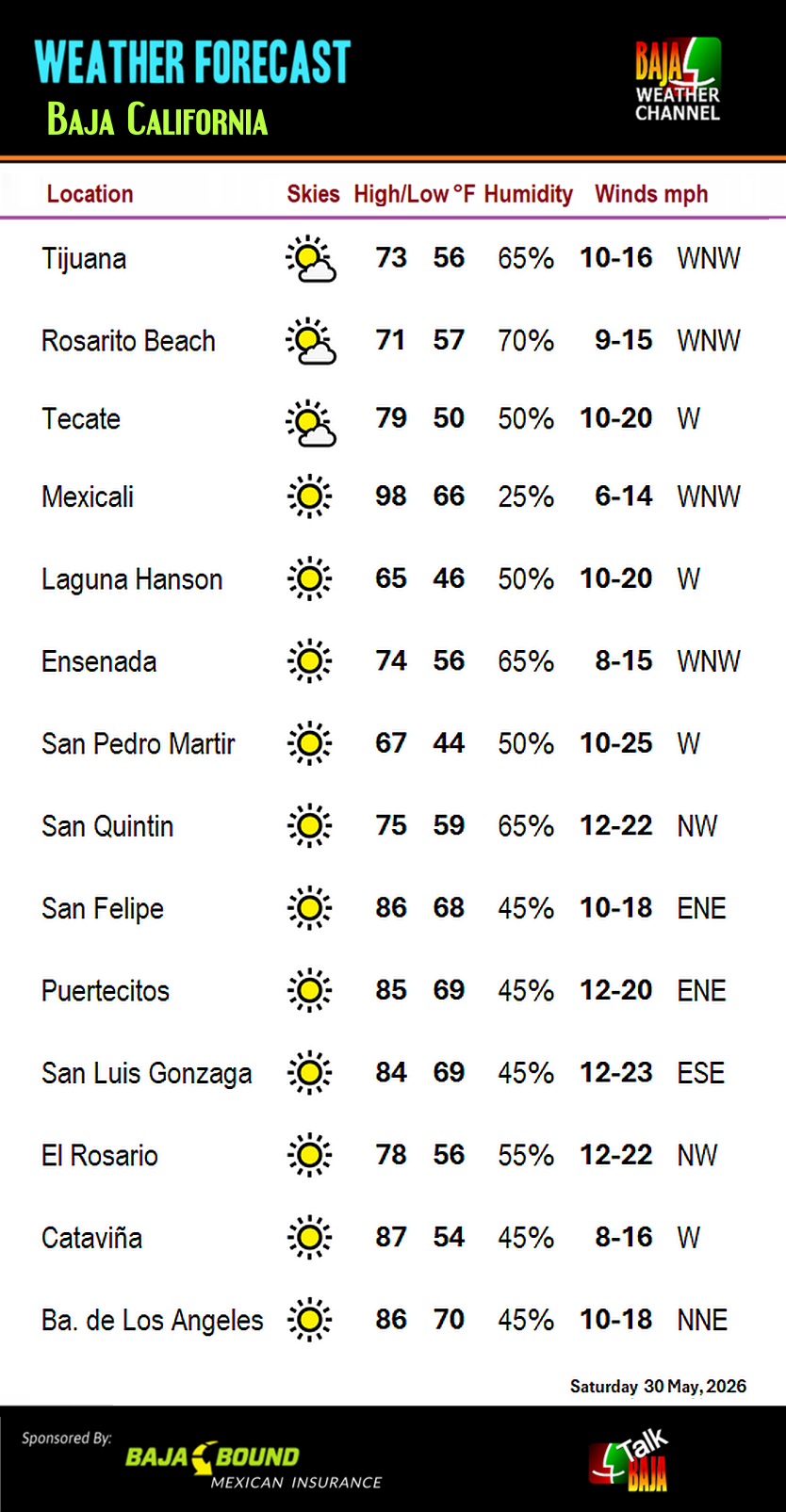

Baja California
Weather across the northern region today is highly dictated by sharp topographic boundaries and intense microclimates.
Along the Pacific beaches, Tijuana and Rosarito Beach are experiencing mostly sunny skies as the marine clouds scatter out early, keeping temperatures in a comfortable, warm range.
Just slightly inland, the maritime influence fractures completely under a mostly sunny sky, allowing Tecate to experience a significantly warmer to hot afternoon.
Further down the western shoreline, Ensenada has broken out into mostly sunny skies, while San Quintín enjoys mostly sunny skies after an aggressive early morning clearing that pushed the marine deck offshore.
Winds along this western coastal shelf will pulse out of the west-southwest to west at 6 to 12 mph in Tijuana and Ensenada, and out of the west-northwest at 8 to 16 mph in San Quintín, generating choppy sea states with combined wave heights reaching 5 to 8 feet due to an active northwest swell.
Over the mountain spine at Laguna Hanson, conditions are mostly sunny and cool with westerly winds at 12 to 24 mph, while the San Pedro Mártir high sierra remains sunny and cool with southeasterly winds at 10 to 22 mph.
Descending the eastern slopes into the deep desert floors, the atmosphere transforms into a true thermal engine.
Under brilliant, unfiltered sunshine, the Mexicali Valley turns exceptionally hot, while the coastal strip from San Felipe through Puertecitos and down to Bahía San Luis Gonzaga turns much warmer to hot.
A localized pressure gradient is forcing winds from the east-southeast at 8 to 16 mph in San Felipe, south-southeast at 10 to 18 mph in Puertecitos, and east-southeast at 12 to 22 mph near Bahía San Luis Gonzaga, whipping up choppy surface waters with seas building to 3 to 4 feet in the northern Gulf of California.
Rain is completely out of the equation across the northern region today.


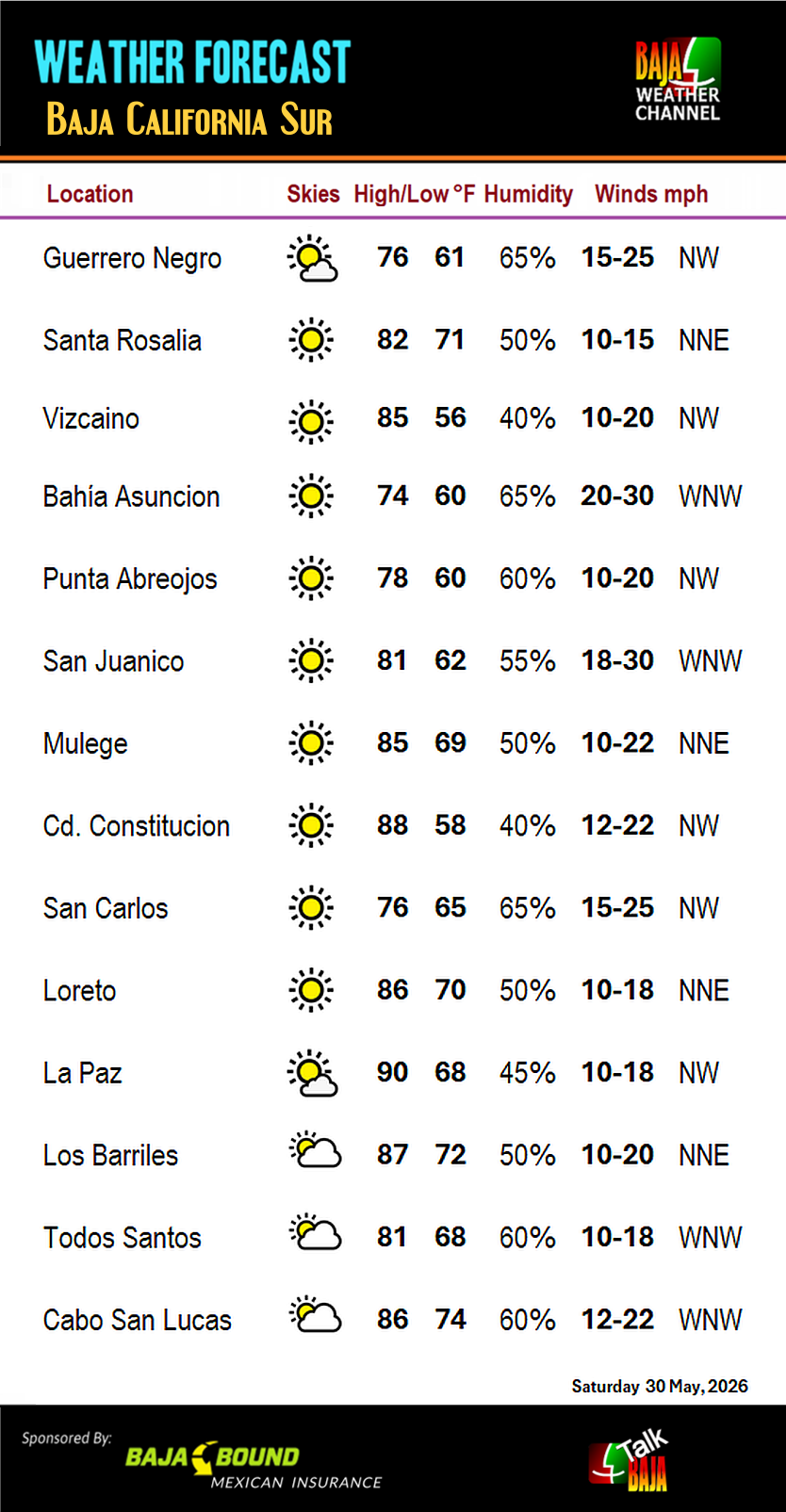
Baja California Sur
Weather across the southern region is forecast to range from much warmer to quite hot today as extensive sunshine overrides any lingering high-level atmospheric moisture.
Along the central-southern Pacific coastline, areas including Guerrero Negro and Bahía Asunción are enjoying mostly sunny skies, while Punta Abreojos and San Juanico are completely sunny.
The immediate shoreline stays in a comfortable, warm range rather than cool, as intense solar gains mitigate the chilly offshore waters, while moving just slightly inland into the Vizcaíno Valley turns the environment hot.
An active marine breeze will pulse out of the northwest at 15 to 25 mph across Guerrero Negro, Bahía Asunción, and San Juanico, while Punta Abreojos sees stronger west-northwesterly winds at 20 to 30 mph, keeping near-shore sea states moderately choppy to rough at 6 to 8 feet.
In the central desert valley, Ciudad Constitución remains under clear, sunny skies and turns exceptionally hot, accompanied by afternoon west-northwesterly winds at 14 to 24 mph.
Along the western shorelines of the Gulf of California, conditions remain beautifully clear, stable, and warm. Unbroken sunshine is heating Santa Rosalía, Mulegé, and Loreto into a much warmer to hot afternoon bracket.
Winds pulse from the north-northeast at 7 to 16 mph in Santa Rosalía, from the northeast at 10 to 18 mph in Mulegé, and from the east-southeast at 7 to 15 mph in Loreto, keeping the near-shore sea states highly stable, smooth, and flat at 3 to 5 feet.
Around the state capital of La Paz, conditions turn rather hot under sunny skies, with an afternoon breeze out of the west at 10 to 15 mph. Down along the southern Pacific cape, brilliant sunny skies bring warmer conditions to Todos Santos alongside steady west-northwesterly breezes at 8 to 16 mph.
At the extreme southern tip, Cabo San Lucas is seeing much warmer to hot conditions under mostly sunny skies with westerly winds blowing at 12 to 22 mph. Los Barriles stays sunny and hot under a light to moderate northeasterly breeze at 10 to 16 mph.
A heavy northwest swell is active offshore, keeping coastal seas around the southern tip running at 4 to 6 feet. Precipitation remains at absolute zero across the southern region.
Wind Forecast Models